
Santa Fe County Court Records After a Jail Arrest
A Santa Fe County jail arrest creates two related records tracks. The custody track begins at the Santa Fe County Adult Correctional Facility and may include booking, local offender ID, booking date, roster status, and any hold or bond information the jail chooses to display. The court track begins when a charging document or case entry is filed. That court record is where the formal charges, hearing dates, judicial orders, bond conditions, amendments, dismissals, pleas, verdicts, and sentence entries are tracked.
The First Judicial District Attorney's Office prosecutes felony and many state criminal cases for Santa Fe, Rio Arriba, and Los Alamos Counties on behalf of the State of New Mexico. The office site names Mary Carmack-Altwies as District Attorney. After law enforcement submits reports and allegations, the prosecutor decides what to file and whether to amend, reduce, add, decline, or dismiss charges. This is why an arrest-level booking charge is not the final word on the case.
The court record is separate from jail custody data. Use the roster for custody status, use the court systems for charges and hearings, and use DPS for statewide adult arrest-record background checks.
How to Find Santa Fe County Court Records After an Arrest
The statewide public case routes are New Mexico Courts Case Lookup and Odyssey Public Access. Case Lookup is for viewing individual electronic court records and warns against attempts to download multiple records per transaction. Odyssey Public Access gives a public access entry where users select a location and then use case search. If displayed information appears wrong, the courts direct users to the court where the case was heard.
- Start with the defendant's full legal name, date of arrest or booking, and any case number from jail paperwork or citation documents.
- Use New Mexico Courts Case Lookup or Odyssey Public Access and select the relevant court location if the portal requires it.
- Search by case number when known; otherwise search by party or defendant name and narrow by court or date range.
- Open the case record and read the charge list, hearing calendar, bond or release orders, and disposition entries separately.
- If the electronic case is missing, inspect records at the court clerk's office or use the New Mexico Courts IPRA form.
The New Mexico Courts Case Lookup is the main statewide entry for individual electronic court records.
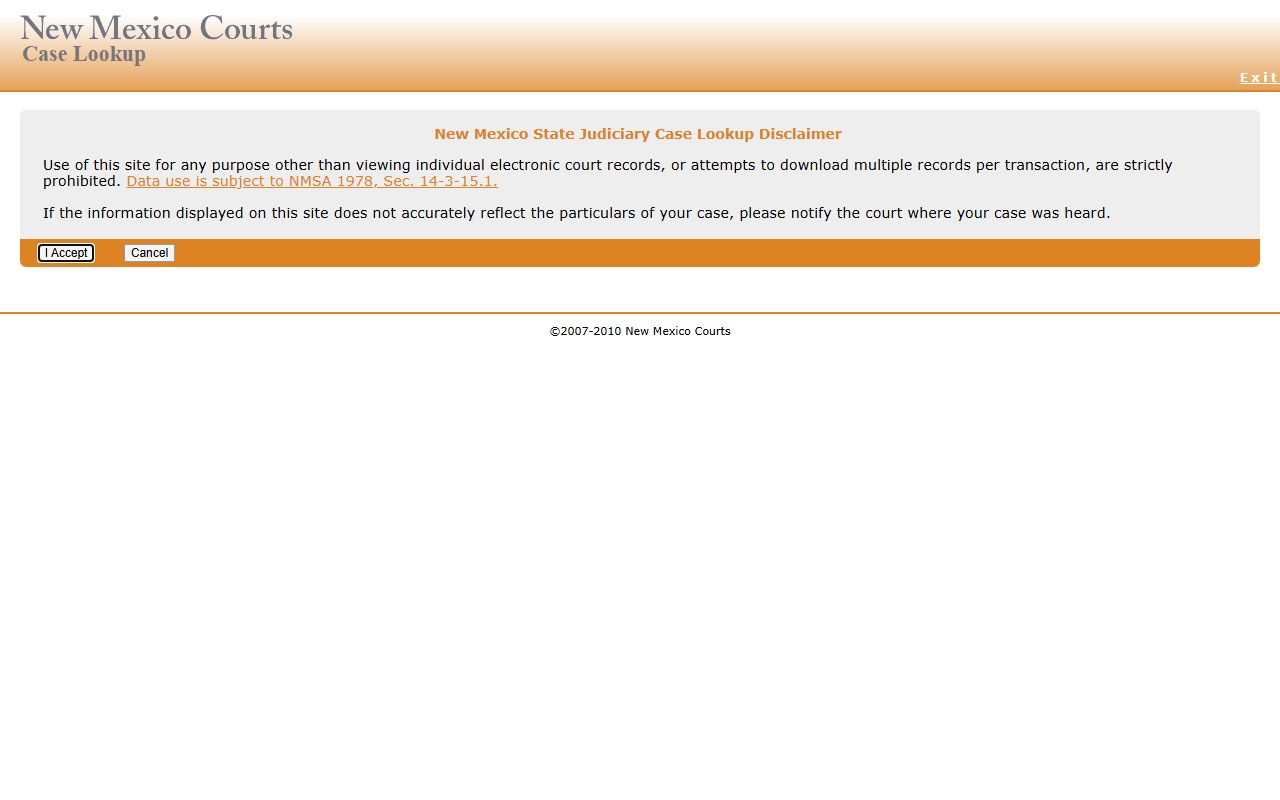
That statewide portal is the right place to look for filed charges after a Santa Fe County arrest, while jail booking questions remain with the county jail roster and facility contacts.
Court Search Fields for Records After an Arrest
Search fields vary by portal, but the research confirmed the core fields and navigation paths below. Case number is usually the cleanest route when available, while name searches require careful matching because spelling, middle names, and aliases can affect results.
| Field Label | Type | Required | Notes |
|---|---|---|---|
| Location | Dropdown/navigation | Usually required | Odyssey Public Access says to select a location before case search. |
| Case Search | Navigation/search mode | Required | Public Access entry point for searching cases. |
| Case number | Text | Optional if known | Best precision when copied from paperwork, a citation, or a court notice. |
| Party/defendant name | Text | Optional | Use full legal name; middle initial or date context helps avoid mismatches. |
| Court | Location/filter | Optional or required by portal | Santa Fe cases may be district, magistrate, municipal, or appellate depending on case type. |
| Date range | Date/filter | Optional | Useful when looking soon after a recent arrest. |
How Charges Get Filed After an Arrest: Complaint, Information, and Indictment
Booking is not the same as prosecution. The jail receives the person and creates the custody record. The court case begins or develops when a charging document is filed. Santa Fe County state prosecutions may involve a criminal complaint, a prosecutor-filed information, an indictment, or an amended filing depending on the offense, court, and procedural stage.
| Document | Filed By | What It Usually Means | Why It Matters |
|---|---|---|---|
| Complaint | Officer or prosecutor | Often an early charging document after arrest or citation. | May start the court case and first hearing path. |
| Information | Prosecutor | A formal prosecutor-filed charging document. | Can replace or refine earlier arrest-level allegations. |
| Indictment | Grand jury | Formal grand-jury charging document. | Often associated with more serious felony prosecution routes. |
| Amended charging document | Prosecutor or court-authorized filer | Changes, adds, reduces, or clarifies counts. | Explains why court records after arrest can differ from the jail booking entry. |
Charge Status in Court Records After Arrest
Charge status is not static. A booking entry may reflect the arresting agency's early allegation, while the court record shows the prosecution's formal position and the judge's orders. Read each count separately because one charge can be pending while another is dismissed, amended, or resolved by plea.
| Status | What It Means | Practical Check |
|---|---|---|
| Pending | The charge remains open and has not reached final disposition. | Check upcoming hearings and bond/release orders. |
| Amended | The filed charge was changed after the original filing. | Compare the original complaint with later information or amended filings. |
| Reduced | The case moved to a lesser charge or lower severity. | Read the final disposition, not just the booking charge. |
| Dismissed | The court or prosecutor ended that count without conviction. | Confirm whether other counts remain open. |
| Convicted | A plea, verdict, or judgment resulted in conviction on that count. | Review sentencing and conditions separately. |
| Warrant active or recalled | A warrant may have issued for missed court or noncompliance, then later been cleared. | Verify with the issuing court or Warrants Division. |
Bond, Release Orders, and Holds After an Arrest
Santa Fe County's inspected jail pages did not publish a detailed bond-payment page or local fee schedule. Bond questions should be routed through the court handling the case and the jail front desk rather than guessed from other counties. After arrest, the court can order release on recognizance, release with conditions, secured bond, cash-only or surety bond where permitted, or detention/no-release conditions. A separate hold or detainer can keep the person in custody even when local bond appears payable.
| Bond Type | How It Works | Santa Fe County Note |
|---|---|---|
| Personal recognizance | Release based on a promise to return and follow conditions. | Verify in the court case because the jail does not set final conditions alone. |
| Cash bond | Money deposited as ordered by the court. | Payment location and method were not published on inspected jail pages. |
| Surety bond | A licensed bail agent posts bond under a contract. | Confirm that the court order permits surety before relying on this route. |
| No-bond or detention order | Payment alone will not release the person. | May involve serious charges, warrant terms, probation/parole holds, or a judge's order. |
| Hold or detainer | Another agency or case prevents release. | Check the court case, jail, warrant division, and state or federal systems. |
Warrants That Lead to an Arrest
Santa Fe County did not show a complete searchable active-warrant database in the official pages inspected. The Sheriff's Office does publish a Warrants Division contact at 505-986-2491 and hotsheet incident summaries that include warrant arrests. Those hotsheets can provide recent local context, including case number, incident type, date, deputy, location, and arrestee information, but they are not a legal clearance tool.
For a possible warrant, search the underlying court case, call the issuing court, or contact the Sheriff's Warrants Division. Municipal bench warrants may appear through the Santa Fe Municipal Court public portal. Older court files or warrant-related documents may require the clerk's office or a court IPRA request. A person who believes a warrant is active should not rely on a generic web search to decide whether the warrant has been cleared.
Charges vs. Convictions
An arrest and charge are allegations. A conviction is a final court outcome based on a plea, verdict, or judgment. Santa Fe County court records after an arrest may contain both dismissed allegations and convictions, so each count should be read by status and disposition.
| Charge | Conviction | |
|---|---|---|
| Stage | Accusation or formal count filed in court. | Final result after plea, verdict, or judgment. |
| Proof level | Based on probable cause or prosecutor filing standards. | Requires the court process to reach a conviction outcome. |
| Can change? | Yes, charges may be amended, reduced, added, or dismissed. | Can still be affected by appeal, post-conviction relief, sealing, or expungement where available. |
| Use caution | Does not prove guilt. | Still verify the exact offense, sentence, and current legal status. |
Sealed vs. Expunged Court Records After an Arrest
New Mexico public-records access is limited by confidentiality rules, protected identifiers, juvenile restrictions, sealed case rules, and law-enforcement exceptions. The research did not provide a page-specific Santa Fe County expungement procedure, so the safest wording is procedural: check the court record, consult the court clerk or counsel, and use official New Mexico court resources for eligibility and filing requirements.
| Sealed | Expunged | |
|---|---|---|
| Public visibility | Hidden or restricted from ordinary public access. | Removed or treated under expungement rules if granted by law and court order. |
| Who may still see it | Access may remain for courts, law enforcement, or authorized parties. | Access depends on the governing order and New Mexico law. |
| How it affects lookup | Electronic portals may omit or restrict the case or documents. | Public search results may no longer show the record, but official handling depends on the order. |
| Next step | Contact the court clerk or attorney about the sealing order. | Use official court channels to confirm eligibility and order scope. |
District Attorney and Prosecutor Role
The First Judicial District Attorney's Office serves Santa Fe, Rio Arriba, and Los Alamos Counties. The New Mexico Administrative Office of the District Attorneys lists the Santa Fe County main office at the Santa Fe Law Enforcement Complex, 327 Sandoval Street, Santa Fe, NM 87501, with telephone 505-827-5000. The office includes functions such as victim/witness assistance, trial teams, investigators, intake, diversion, administration, and support teams.
The First Judicial District Attorney site identifies the office and its prosecution role for the district.
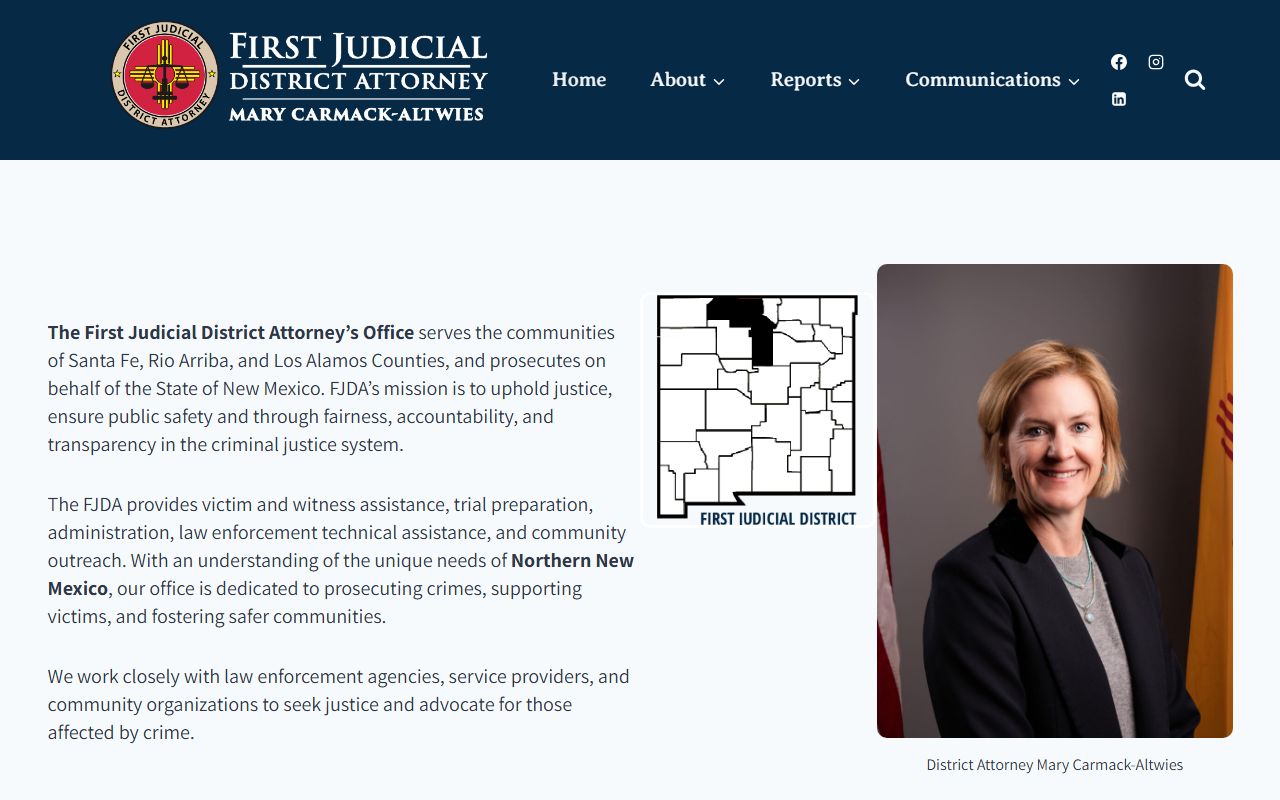
That office is central to court records after a jail arrest because prosecutor filings can transform an arrest allegation into the formal charges shown in the court record.
DPS Background Checks and Court IPRA Requests
The New Mexico Department of Public Safety Law Enforcement Records Bureau maintains the state central repository for adult arrest records for felony, qualifying misdemeanor, and DWI offenses. DPS publishes a $15 adult arrest-record check fee by money order or cashier's check payable to NMDPS. A police certificate or good-standing certification with background check costs $33. The DPS process is mail-based, requires the published release and payment, and lists a 7-15 working day turnaround depending on volume and workload.
New Mexico Courts also provides public-records access routes. The courts public-records hub points to Case Lookup, re:SearchNM for registered access, and court IPRA. The court IPRA page says court case records may be inspected at the clerk's office where records are located or requested through the form, and copy fees may apply. It also warns that New Mexico Courts do not conduct criminal background checks for the public and do not maintain law-enforcement, driving, or marriage records.
Important: Public case lookup is not a consumer report and should not be used for FCRA-covered decisions.
Restricted Court Records After an Arrest in Santa Fe County
New Mexico's Inspection of Public Records Act gives a broad right to inspect public records, but it does not make every record public in full. Protected personal identifiers may be redacted. Law-enforcement records can be withheld when disclosure would reveal confidential sources or methods or seriously interfere with an investigation. Juvenile matters, sealed records, expunged records, and confidential case materials can be restricted.
The Arrest Record Information Act has its own dissemination and confidentiality rules, and the NMDOJ IPRA guide notes that some identifying arrest information may remain subject to disclosure even when investigative details are withheld. For court records after a jail arrest, the practical rule is to use the public case portals first, then the clerk or court IPRA route for records that are not online.